You may have already considered this, but your diagram suggests a collision (of a point mass with a spherical mass) that's perfectly tangent to the surface of the sphere. While the elastic point-mass/spherical-mass model portion of the model is a good approximation (I think it does make sense to model Entity A as a sphere and Entity B as a point), shouldn't you also include a factor for the angle of incidence (theta, below), as it's likely that Entity B is likely to strike Entity A at a non-90-degree angle?
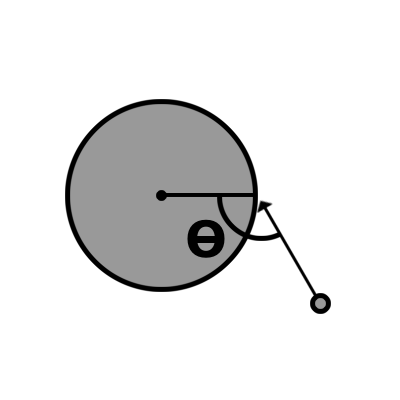
For a collision that's not perfectly tangential to the sphere, your angular momentum transfer will be less (and the linear momentum transfer greater), so the actual momentum transfer will occur more like...
angular_momentum_change = your_angular_formula * sin(theta)
linear_momentum_change = your_linear_formula * cos(theta)
...so that in a head-on collision, there's no change in angular momentum (it's all linear), whereas in a tangential collision, there's no change in linear momentum (it's all angular).
So, none of that actually answers your question, and only makes your life harder, but it may help in the long-run(?)